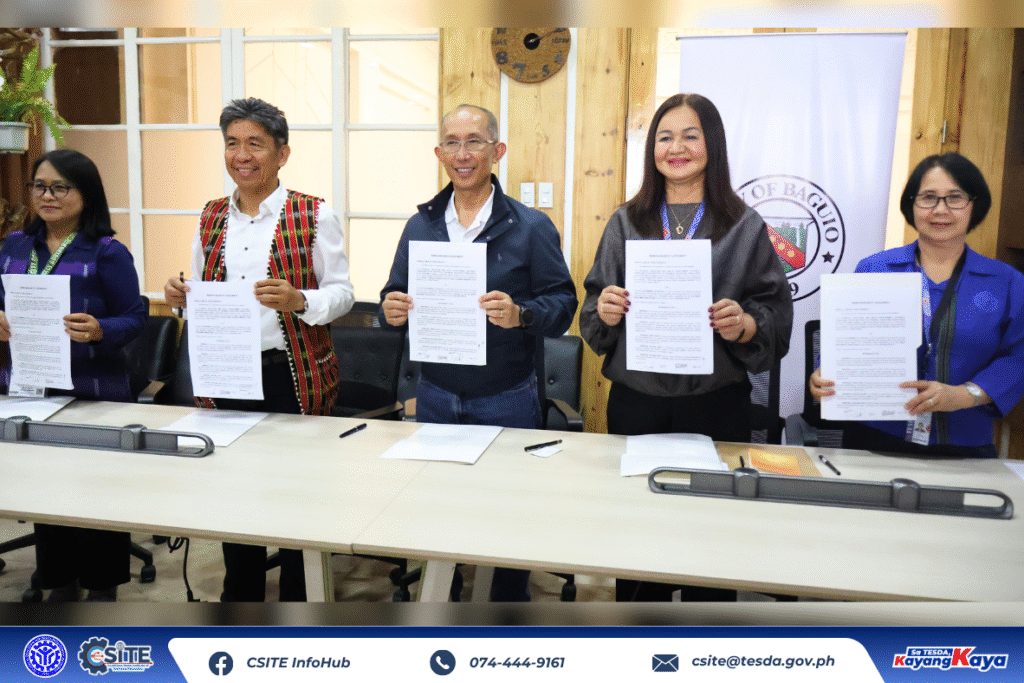
The Technical Education and Skills Development Authority – Cordillera State Institute of Technical Education (TESDA-CSITE) and the City Government of Baguio formally signed a Memorandum of Agreement (MOA) on May 7, 2026, to strengthen technical-vocational education and training (TVET), particularly in Early Childhood Care and Development (ECCD) and other social and community development service sectors.
ECCD refers to programs and services that support the holistic growth and development of young children, including their health, nutrition, education, and social well-being during their formative years.
The Memorandum of Agreement was formally signed at Baguio City Hall by TESDA-CAR Acting Regional Director Engr. Glenn N. Murphy and Baguio City Mayor Benjamin Magalong. Witnessing the signing were TESDA-CSITE Executive Director Daisy C. Bungallon, City Social Welfare and Development Officer Liza D. Bulayungan, and CSITE Main Campus Administrator Melita D. Pinic.
Under the agreement, TESDA-CSITE and the City Government of Baguio committed to jointly implement programs that will enhance skills training, supervised industry learning, competency assessment, and employment facilitation for various sectors of the community, including women, youth, senior citizens, and other vulnerable groups.
The partnership also aims to strengthen industry-academe collaboration through the development of competency-based training programs and the expansion of opportunities in the Social and Community Development Services sector, particularly in ECCD-related qualifications.
As part of the agreement, the City Government of Baguio, through the City Social Welfare and Development Office, will allow the use of Child Development Centers across the city as venues for supervised industry learning, industry immersion activities, and competency assessments. TESDA-CSITE, meanwhile, will oversee curriculum development, training implementation, learner monitoring, and competency assessment in accordance with TESDA standards and guidelines.
The MOA will remain effective for three years and is expected to further support accessible, industry-responsive, and community-based technical education programs in Baguio City.